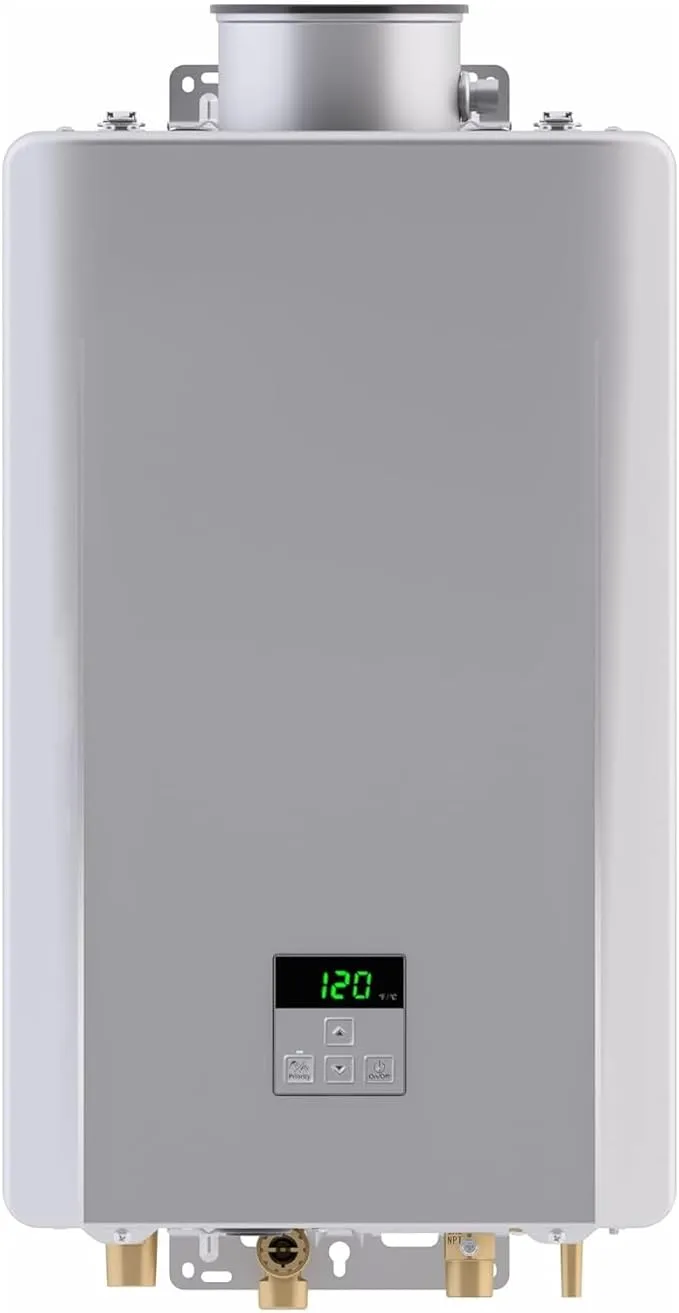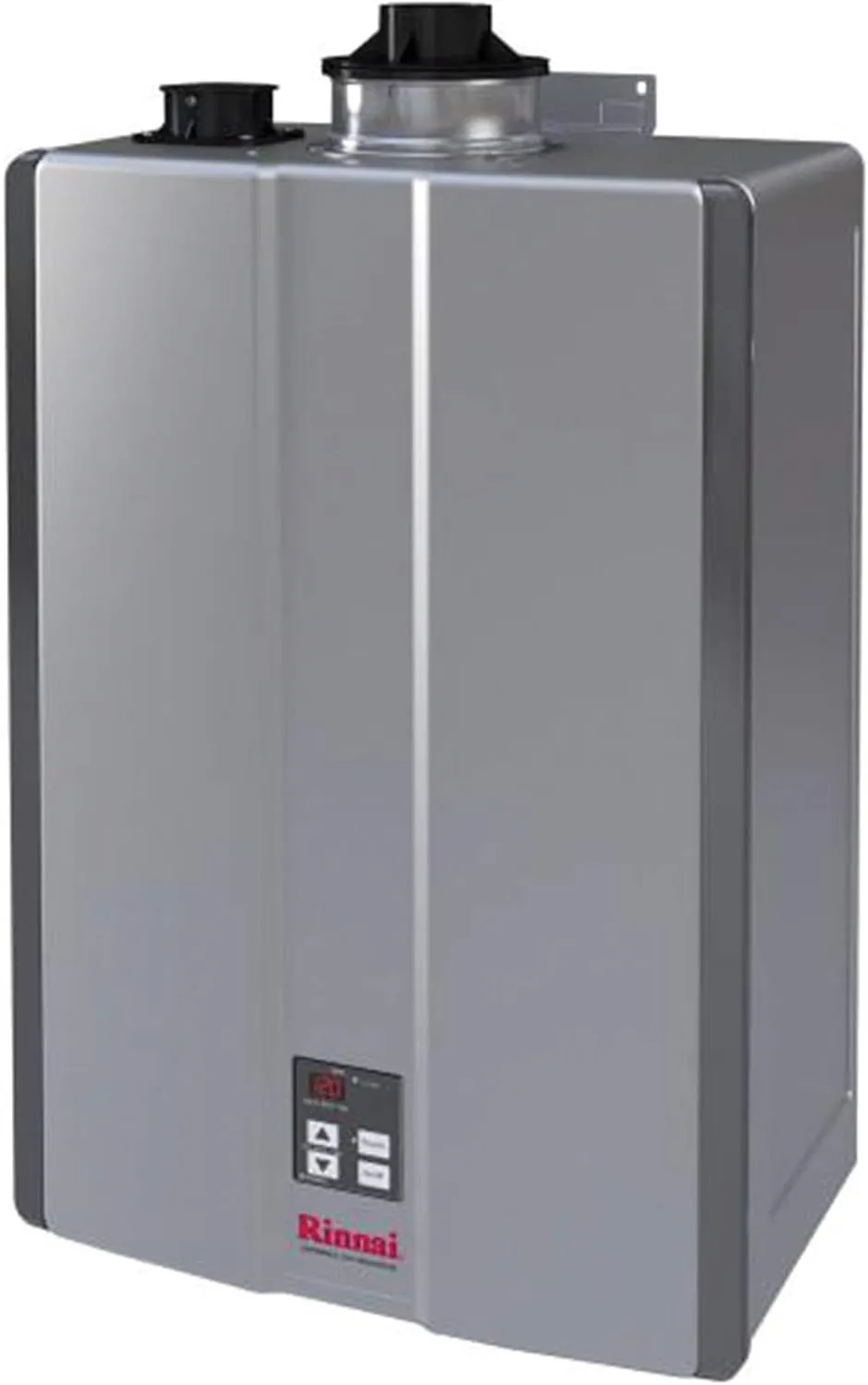
Rinnai RU180eP
Amazon customer rating as of
Tankless Geek editorial score: 4.6/5
The Rinnai RU180eP is the outdoor, propane version of the SENSEI Super High Efficiency Plus line — 180,000 BTU/h and up to 10.0 GPM at roughly 0.95 UEF. The 'e' denotes external (outdoor) installation and the 'P' denotes liquid propane, which together make it a natural fit for homes off the natural-gas grid: mounted outside, it needs no indoor venting run at all, since the exhaust simply discharges to open air.
As a condensing unit it recovers exhaust heat for high efficiency, and at 10.0 GPM it's one of the higher-output residential tankless heaters available — enough for a large home running several fixtures at once in most climates. It modulates from 15,000 BTU/h, activates at 0.4 GPM, holds 98–140 °F, and is Wi-Fi and recirculation capable. Because it lives outdoors, continuous power is essential for its built-in freeze protection.
Key Features
Best Use Cases
Our Verdict
The RU180eP earns its place for propane households that want serious flow without sacrificing an interior wall to a vented indoor unit. Ten GPM and ~0.95 UEF put it near the top of the residential range, and outdoor mounting sidesteps venting cost and complexity entirely. The trade-offs are propane-specific: LP is more expensive per BTU than natural gas, and condensing recirculation — while supported — compounds that fuel cost, so it should be used judiciously. Owners of the SENSEI outdoor units praise the endless high-volume hot water and clean exterior install; the standing cautions are propane consumption, occasional Code 11 ignition faults, and the need to keep the unit powered year-round for freeze protection. Our take: an excellent high-flow choice for a larger propane home in a mild-to-moderate climate — just size your propane supply and budget for LP running costs.
Technical Specifications
| Max gas input | 180,000 BTU/h |
|---|---|
| Min gas input (modulation) | 15,000 BTU/h |
| Max flow rate | 10.0 GPM |
| Activation flow | 0.4 GPM |
| Fuel | Liquid propane (LP) |
| Efficiency (UEF) | 0.95 · condensing |
| Temperature range | 98–140 °F |
| Installation | Outdoor (external) — no indoor venting |
| Dimensions (W×H×D) | 18.5 × 27.9 × 12.0 in |
| Weight | 64 lb |
| Gas / water connections | ¾ in MNPT |
| Wi-Fi | Capable via Control-R module (sold separately) |
| Recirculation | Capable (external pump) |
| Emissions | Ultra-Low-NOx · SCAQMD approved |
| Warranty | 15 yr heat exchanger (or 12,000 hrs) · 5 yr parts · 1 yr labor |
Specifications verified against the linked source documents. See Sources below.
How much hot water you'll actually get
Usable flow drops as incoming water gets colder. Figures are calculated from rated output (180,000 BTU × 0.95 UEF) and labeled as such — not bench-tested by us.
| Temperature rise | Typical scenario | Usable flow |
|---|---|---|
| 35 °F | Warm climate (75 °F in → 110 °F) | 9.8 GPM |
| 45 °F | Mild climate (65 °F in → 110 °F) | 7.6 GPM |
| 60 °F | Cool climate (50 °F in → 110 °F) | 5.7 GPM |
| 70 °F | Cold climate (40 °F in → 110 °F) | 4.9 GPM |
Usable flow calculated from rated output (180,000 BTU × 0.95 UEF), capped at the unit's 10.0 GPM maximum. Propane delivers the same output per BTU as natural gas — the difference is fuel cost, not flow.
Pros
Cons
Buy it if…
- Propane homes that want high flow (up to 10 GPM) for a large household
- Installs where outdoor mounting avoids an indoor venting run
- Mild-to-moderate climates where an outdoor unit stays reliably powered
- Owners who value condensing efficiency even on propane
Skip it if…
- Homes on natural gas — choose the NG SENSEI (e.g. RU160iN/RU199iN) for cheaper fuel
- Cold-climate installs prone to power outages — an outdoor unit risks freezing if it loses power
- Budget-focused buyers — propane running costs and condensing price add up
- Small homes that will never use anywhere near 10 GPM
Installation Requirements
Professional vs DIY
Outdoor mounting skips venting, but LP sizing and the high output make a licensed installer the safe choice.
Gas and electrical work should be done by a licensed professional, and most installs require a permit and must meet local building codes — DIY work can void the manufacturer warranty. Always confirm the unit's own manual for exact clearances, venting, and sizing.
What owners report
Themes summarized from retailer customer feedback (4.4/5 Amazon customer rating, 77 ratings, as of 2026-08-23). These are owner opinions, not our own bench testing.
High-volume, never-ending hot water — SENSEI owners note it keeps up with several fixtures at once, a real benefit in larger homes.
Outdoor mounting eliminates the indoor venting run and frees up interior space; owners like the clean exterior install.
Propane consumption is high relative to natural gas, and enabling recirculation increases it further — a recurring cost caution in reviews.
Occasional Code 11 (ignition) faults reported across the SENSEI line, often resolved with a power cycle or by verifying LP supply pressure.
As an outdoor unit it depends on continuous power for freeze protection; owners in colder areas stress keeping it energized and insulating exposed pipe.
Rinnai RU180eP FAQ
Why choose the outdoor propane version over an indoor gas one?+
Two reasons: your home is on propane rather than natural gas, and outdoor mounting means no indoor venting to route or pay for. If you're on natural gas, an indoor NG SENSEI will cost far less to run — propane is the more expensive fuel per BTU.
Will it freeze in winter?+
It has built-in freeze protection, but that protection only works while the unit has power. Outdoors, a winter power outage is the real risk — keep it energized year-round and insulate any exposed water lines. The unit protects itself; it can't protect your external plumbing.
How much hot water does 10 GPM really give me?+
In a warm climate, close to the full 10 GPM — several showers plus a tap. In a cold climate the usable figure drops to roughly 5 GPM at a 70 °F rise, still enough for two simultaneous showers. It's genuinely a large-home unit.
Does recirculation work on propane?+
Yes, it's recirculation-capable with an external pump, but on propane the convenience comes at a clear fuel cost. Many owners run recirculation on a schedule or on-demand rather than continuously to keep LP use in check.
What's the warranty?+
Residential coverage is 15 years on the heat exchanger (or 12,000 hours), 5 years on parts, and 1 year of labor — labor extendable to 5 years with timely registration.
Product sources
Specifications verified 2026-08-23. Manufacturer documents are treated as the primary source for model specifications. Retailer pages are used only for customer ratings and owner-feedback themes.
- Rinnai — RU180eP official product page (accessed 2026-08-23)
- Rinnai — SENSEI residential warranty & freeze-protection guidance (accessed 2026-08-23)
- The Home Depot — Rinnai SENSEI 180,000 BTU indoor/outdoor reviews (accessed 2026-08-23)
Price range from leading retailers
* As an Amazon Associate, we earn from qualifying purchases