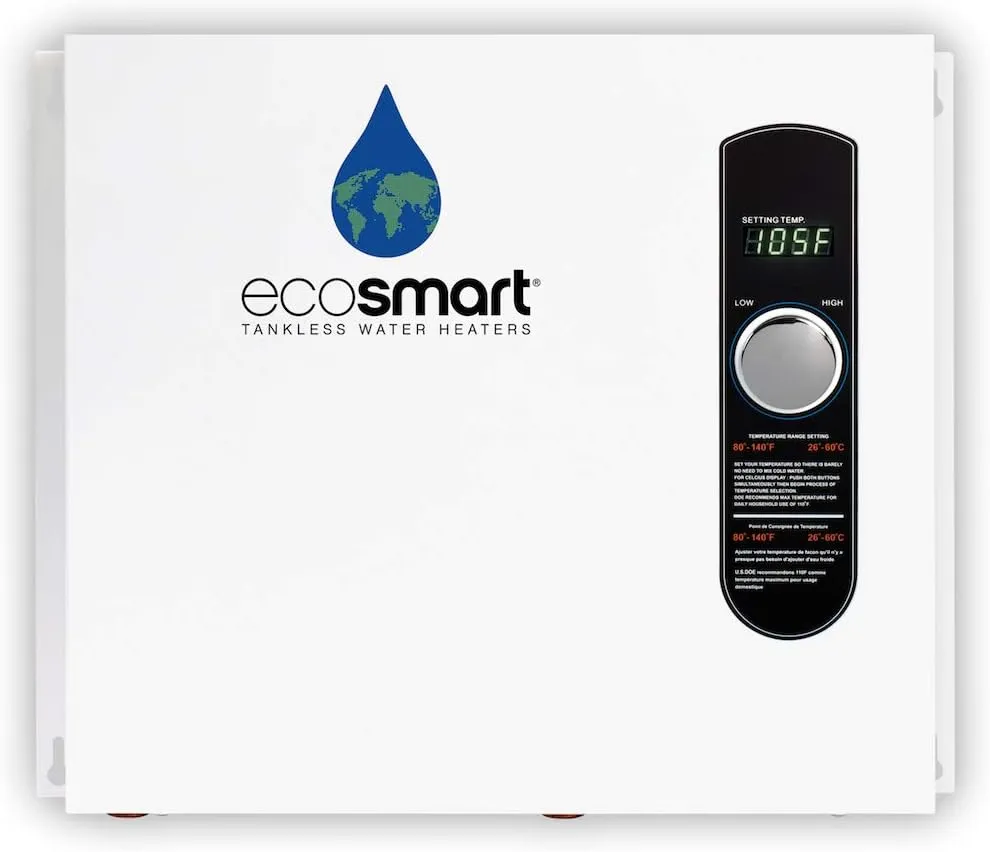
EcoSmart ECO 36
Amazon customer rating as of
Tankless Geek editorial score: 4.2/5
The EcoSmart ECO 36 is the top of the ECO electric line: 36 kW at 240 volts, aimed at whole-home service in homes without natural gas. Four self-modulating heating chambers ramp power to match demand, and a stainless-steel exchanger with digital control fills a compact 17 × 21 × 3.75 in cabinet — a fraction of a tank's footprint with no standby loss.
Thirty-six kilowatts is enough to be a serious whole-home heater: owners in warm and moderate climates run three-plus bathrooms, and even in a cold Northeast winter it holds around 3.5 GPM — enough for a shower plus a sink. But that power comes with the biggest electrical demand of any unit here: roughly 150 amps of draw, typically four double-pole breakers and, in some homes, a service upgrade just to accommodate it. That requirement — not the heater itself — is what stops many buyers. For an all-electric home that can feed it, the ECO 36 is the closest an electric tankless comes to gas-like whole-home performance.
Key Features
Best Use Cases
Our Verdict
The right electric tankless for a whole house without gas — provided your electrical service can handle ~150 A. It delivers genuine multi-bath flow in warm and moderate climates and a solid single-shower-plus in the cold. Price the possible panel or service upgrade into your decision; that, not the heater, is the real cost driver.
Technical Specifications
| Power | 36 kW @ 240 V (~150 A draw) |
|---|---|
| Electrical | Four double-pole breakers · four 8-gauge runs |
| Rated flow | Up to ~6–7 GPM (warm inlet) |
| Chambers | 4 self-modulating heating chambers |
| Dimensions | 17 × 21 × 3.75 in |
| Efficiency | 99.8% (electric resistance) |
Specifications verified against the linked source documents. See Sources below.
How much hot water you'll actually get
Usable flow drops as incoming water gets colder. Figures are calculated from rated output (kW) and labeled as such — not bench-tested by us.
| Temperature rise | Typical scenario | Usable flow |
|---|---|---|
| 35 °F | Warm climate (75 °F in → 110 °F) | 7 GPM |
| 45 °F | Mild climate (65 °F in → 110 °F) | 5.5 GPM |
| 60 °F | Cool climate (50 °F in → 110 °F) | 4.1 GPM |
| 70 °F | Cold climate (40 °F in → 110 °F) | 3.5 GPM |
Usable flow at a 110 °F target from 36 kW: kW × 3412 ÷ (ΔF × 500). This is why the ECO 36 stays useful in the cold where smaller ECO units fail.
Pros
Cons
Buy it if…
- 3+ bathroom all-electric homes in warm/moderate climates
- Cold-climate homes needing a reliable shower-plus-sink electric unit
- Homeowners with (or willing to add) 150 A of service headroom
- Hard-water areas — the stainless exchanger tolerates it well
Skip it if…
- Panels that can't supply ~150 A without an expensive upgrade
- Homes with natural gas — a condensing gas unit will cost less to run
- Buyers unwilling to flush in hard-water regions
Installation Requirements
Professional vs DIY
At ~150 A this is an electrician-and-permit job, not a DIY swap; the panel-capacity check is the make-or-break step.
Gas and electrical work should be done by a licensed professional, and most installs require a permit and must meet local building codes — DIY work can void the manufacturer warranty. Always confirm the unit's own manual for exact clearances, venting, and sizing.
What owners report
Themes summarized from retailer customer feedback (4/5 Amazon customer rating, 1000 ratings, as of 2026-08-23). These are owner opinions, not our own bench testing.
Owners in warm and moderate climates report running multiple bathrooms, calling it the electric unit that finally delivers gas-like capacity.
The most repeated caution: ~150 A of draw means four breakers and, for some homes, a service upgrade before it can even be installed.
Reviewers in hard-water areas recommend periodic cleaning to prevent mineral buildup, though the stainless exchanger holds up well.
Most owners are satisfied, but a minority cite heating-element failures and slow customer service — keep proof of professional installation for the warranty.
EcoSmart ECO 36 FAQ
How much electrical service does the ECO 36 need?+
Roughly 150 A of draw at 240 V — commonly four double-pole breakers with four 8-gauge runs. Many homes need to confirm (or upgrade) their panel/service before installing it.
Will it work in a cold climate?+
Yes, within limits: it holds about 3.5 GPM at a 60–70 °F rise — a shower plus a sink in winter — and much more in warm-inlet conditions.
Is it cheaper to run than gas?+
Usually not. Electric resistance is ~99.8% efficient at the unit, but if you have natural gas, a condensing gas heater typically costs less per gallon depending on local rates.
Does hard water hurt it?+
The stainless exchanger tolerates hard water better than many, but owners in hard-water areas still recommend periodic cleaning to keep flow and temperature stable.
Product sources
Specifications verified 2026-08-23. Manufacturer documents are treated as the primary source for model specifications. Retailer pages are used only for customer ratings and owner-feedback themes.
- EcoSmart ECO 36 official product page (accessed 2026-08-23)
- EcoSmart ECO 36 specification sheet (accessed 2026-08-23)
- Home Depot ECO 36 owner reviews (accessed 2026-08-23)
Price range from leading retailers
* As an Amazon Associate, we earn from qualifying purchases