Rinnai V65iN
Amazon customer rating as of
Tankless Geek editorial score: 4.2/5
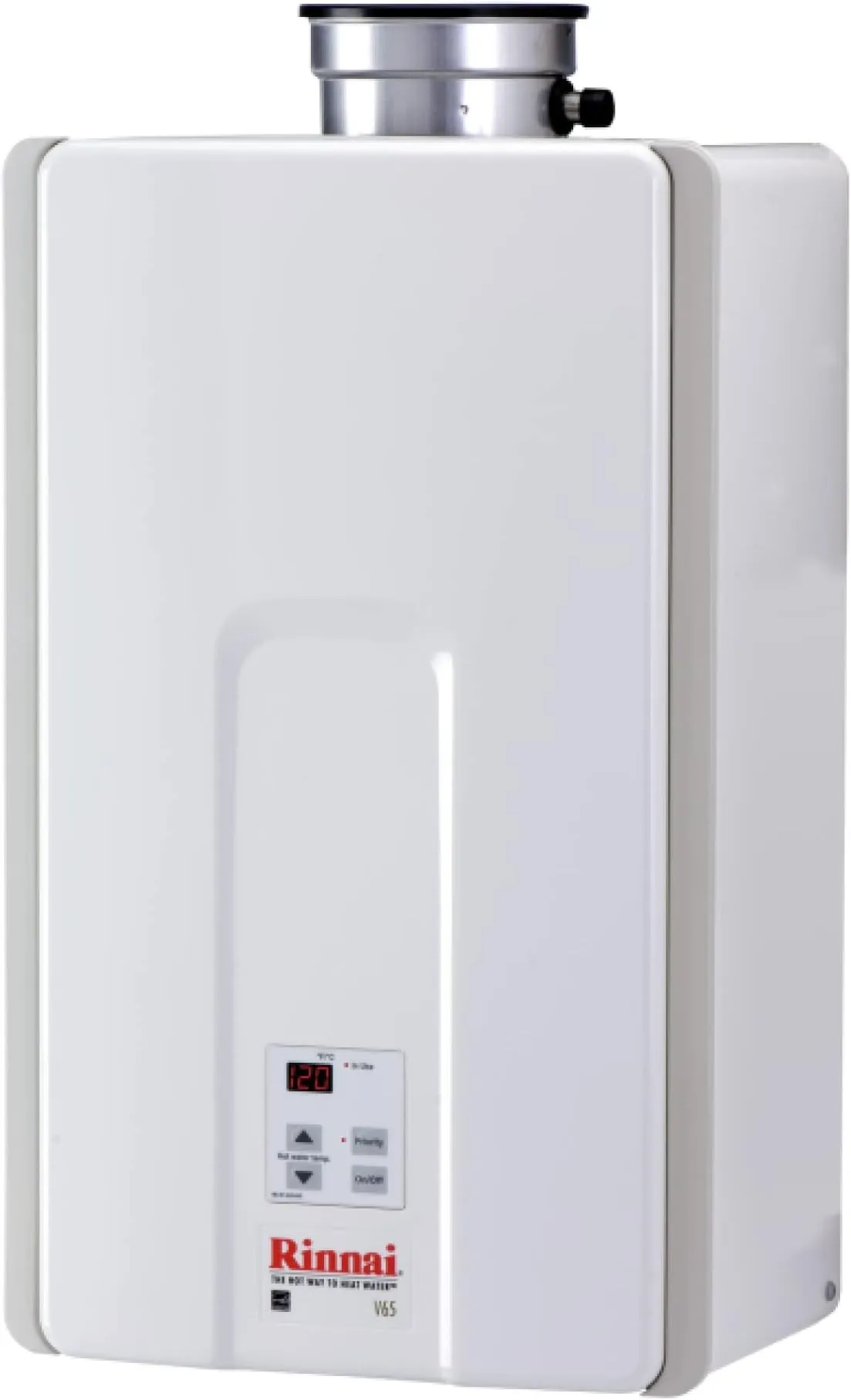
The Rinnai V65iN is the indoor, natural-gas member of the Value series — a non-condensing tankless rated at 150,000 BTU/h and 6.5 GPM. It slots between the smaller V53 and Rinnai's condensing RU line: more flow and indoor installation than the V53DeN, but a lower price than a condensing unit. For a small-to-medium home that wants a genuine indoor gas tankless without paying for condensing efficiency, it's a long-running staple of Rinnai's catalog.
At 0.80 UEF it's non-condensing, so it uses conventional stainless venting rather than plastic. It modulates from 10,300 BTU/h, is approved for high-altitude installation, is Wi-Fi capable, and meets Ultra-Low-NOx requirements. Owners frequently cite long service life as its calling card — several report years of trouble-free use — though like any tankless it rewards correct gas sizing and periodic maintenance.
Key Features
Best Use Cases
Our Verdict
The V65iN is a proven, no-frills indoor gas tankless that has earned its long tenure by simply lasting. Its 6.5 GPM covers a small-to-medium home's typical demand — two fixtures at once in mild climates — and owner reviews repeatedly praise multi-year reliability and the absence of the 'cold-water sandwich.' The honest caveats are that it's non-condensing (0.80 UEF, so higher gas use than a condensing RU), that its 6.5 GPM shrinks in cold-groundwater regions, and that some owners have hit Code 11 ignition faults or valve leaks on aging units, compounded by service support that's easier for licensed techs than homeowners. Our take: a dependable value choice for a small-to-medium home in a moderate climate that wants indoor gas hot water on a budget — step up to a condensing RU160iN if efficiency or higher simultaneous flow matters.
Technical Specifications
| Max gas input | 150,000 BTU/h |
|---|---|
| Min gas input (modulation) | 10,300 BTU/h |
| Max flow rate | 6.5 GPM |
| Efficiency (UEF) | 0.80 · non-condensing |
| Installation | Indoor |
| Dimensions (W×H×D) | 14.0 × 26.9 × 9.3 in |
| Weight | 45.6 lb |
| Gas / water connections | ¾ in NPT |
| High-altitude | Approved for high-elevation installation |
| Wi-Fi | Capable (module sold separately) |
| Venting | Non-condensing (stainless category III) |
| Emissions | Ultra-Low-NOx |
| Warranty | 10 yr heat exchanger · 5 yr parts · 1 yr labor |
Specifications verified against the linked source documents. See Sources below.
How much hot water you'll actually get
Usable flow drops as incoming water gets colder. Figures are calculated from rated output (150,000 BTU × 0.8 UEF) and labeled as such — not bench-tested by us.
| Temperature rise | Typical scenario | Usable flow |
|---|---|---|
| 35 °F | Warm climate (75 °F in → 110 °F) | 6.5 GPM |
| 45 °F | Mild climate (65 °F in → 110 °F) | 5.3 GPM |
| 60 °F | Cool climate (50 °F in → 110 °F) | 4 GPM |
| 70 °F | Cold climate (40 °F in → 110 °F) | 3.4 GPM |
Usable flow calculated from rated output (150,000 BTU × 0.80 UEF), capped at the unit's 6.5 GPM maximum. Non-condensing efficiency yields slightly less usable heat per BTU than a condensing unit.
Pros
Cons
Buy it if…
- Small-to-medium homes wanting an indoor gas tankless on a budget
- Moderate climates where 6.5 GPM covers two simultaneous fixtures
- High-altitude installs (it's approved for elevation)
- Buyers who value a long track record over the latest features
Skip it if…
- Homes chasing efficiency — condensing RU models (~0.92 UEF) cut gas use
- Cold-groundwater regions with heavy simultaneous demand
- Anyone wanting built-in recirculation or the newest connectivity
- Large households that routinely run 3+ hot fixtures at once
Installation Requirements
Professional vs DIY
Gas and Category III venting call for a licensed installer to keep the install safe and the warranty intact.
Gas and electrical work should be done by a licensed professional, and most installs require a permit and must meet local building codes — DIY work can void the manufacturer warranty. Always confirm the unit's own manual for exact clearances, venting, and sizing.
What owners report
Themes summarized from retailer customer feedback (4.5/5 Amazon customer rating, 157 ratings, as of 2026-08-23). These are owner opinions, not our own bench testing.
Longevity is the standout — owners report years of dependable service, some with a unit still going strong after 5+ years and only a single service call.
Steady output with no 'cold-water sandwich,' delivering consistent indoor hot water for small-to-medium homes.
Some owners have encountered Code 11 (igniter) failures, and a few report valve leaks and repair costs on units several years old.
Service support is described as easier for licensed technicians than for homeowners, with warranty claims routed through pros.
The 6.5 GPM rating isn't fully achievable in cold-groundwater regions, where usable flow drops noticeably.
Rinnai V65iN FAQ
How many fixtures can the V65iN run at once?+
In a mild climate, about two — two showers, or a shower plus a kitchen tap — at up to 6.5 GPM. In cold-groundwater regions the usable figure falls toward 3–4 GPM, closer to one heavy fixture plus a light one. For more simultaneous demand, consider a condensing RU model.
Is it efficient?+
It's non-condensing at 0.80 UEF, so it's less efficient than a condensing unit (~0.92 UEF) and uses conventional stainless venting. You save on purchase price; a condensing RU saves more on gas over time. Which wins depends on how much hot water you use.
Why do owners praise its reliability?+
The V65iN has been in Rinnai's lineup a long time and owner reviews frequently cite multi-year, trouble-free service. Like any tankless, that longevity depends on correct gas-line sizing at install and periodic descaling/maintenance.
Can it be installed at high altitude?+
Yes — it's approved for high-elevation installation, which is one reason it's a common choice in mountain-region homes. Confirm the specific altitude limit and any setup steps in the installation manual for your elevation.
What's the warranty?+
10 years on the heat exchanger, 5 years on parts, and 1 year of labor — the Value-series coverage. Rinnai's RE (15-year) and SENSEI lines carry longer heat-exchanger warranties.
Product sources
Specifications verified 2026-08-23. Manufacturer documents are treated as the primary source for model specifications. Retailer pages are used only for customer ratings and owner-feedback themes.
- Rinnai — V65iN official product page (accessed 2026-08-23)
- The Home Depot — Rinnai 6.5 GPM 150,000 BTU indoor reviews (owner feedback) (accessed 2026-08-23)
- Amazon — Rinnai V65iN listing (rating & buyer reviews) (accessed 2026-08-23)
Price range from leading retailers
* As an Amazon Associate, we earn from qualifying purchases