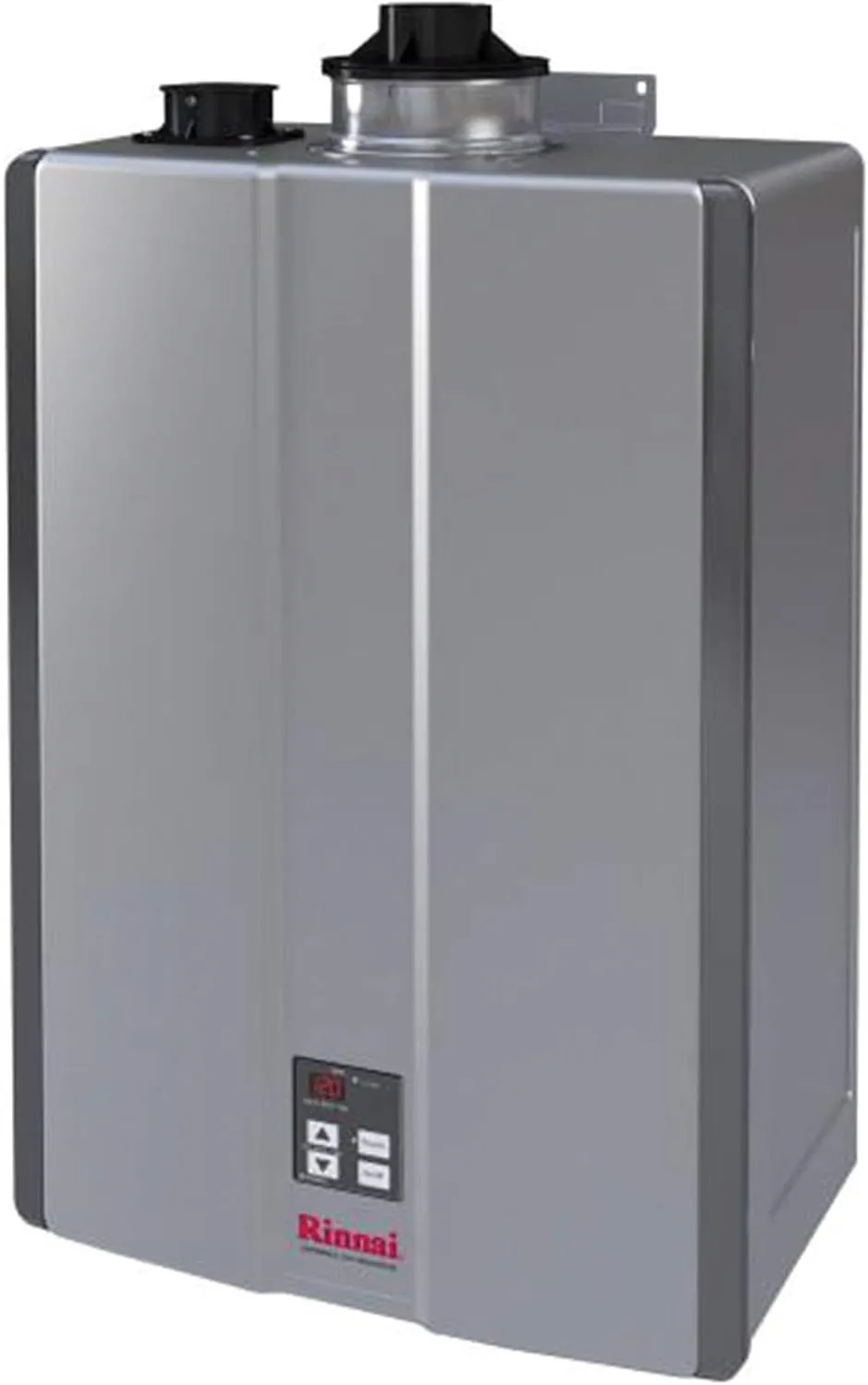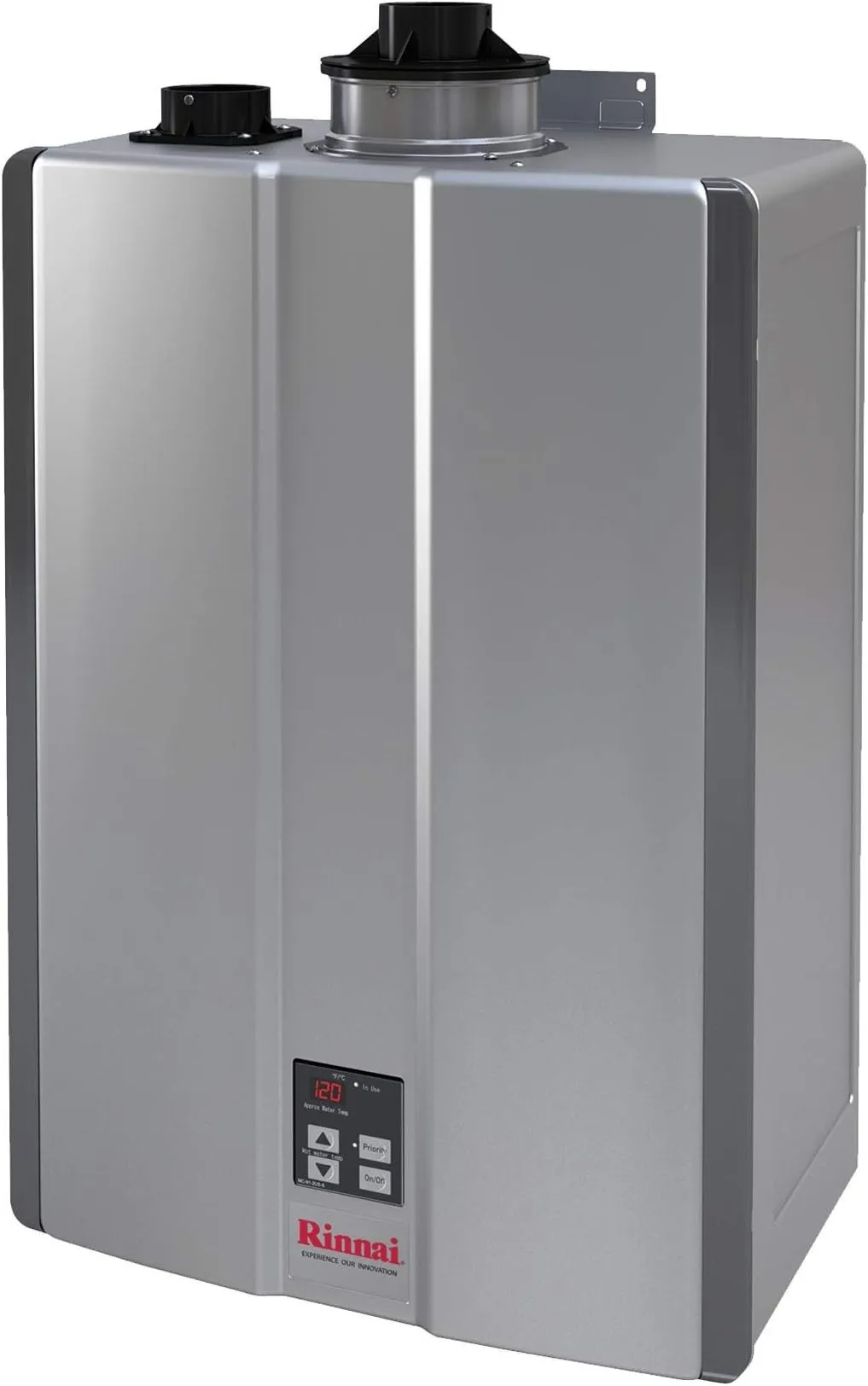
Rinnai RU160iN
Amazon customer rating as of
Tankless Geek editorial score: 4.5/5
The Rinnai RU160iN is the indoor, natural-gas member of Rinnai's SENSEI Super High Efficiency Plus line — a condensing tankless rated at 160,000 BTU/h and up to 9.0 GPM. Where the RE and V series are built to a price, the RU160iN is built for output and efficiency: a secondary condensing heat exchanger pulls extra heat out of the exhaust, pushing it to roughly 0.92 UEF (ENERGY STAR certified) and allowing cooler PVC/polypropylene venting instead of stainless.
It modulates from 15,000 up to 160,000 BTU/h, activates at 0.4 GPM, and holds temperature from 98 to 140 °F. At 9.0 GPM it is a genuine whole-home unit for most climates — three showers at once in warm regions, or two plus a kitchen tap in cold ones. It's Wi-Fi capable and recirculation capable out of the design, though both the Control-R module and an external pump (or the RXP recirc-pump variant) are the paths to those features.
Key Features
Best Use Cases
Our Verdict
The RU160iN is the sweet spot in Rinnai's residential lineup for a whole-home condensing unit that isn't the flagship. Its 9.0 GPM and 0.92 UEF cover the vast majority of North American homes while cutting gas use meaningfully versus a non-condensing RE or V. You give up the RX/RUR series' higher UEF and built-in recirculation, but you also skip their price. Owner feedback is strongly positive on endless, steady hot water and the compact indoor footprint; the recurring cautions are Code 11 ignition faults (usually a power-cycle fix), the extra cost of the Wi-Fi module, and the reality that recirculation burns noticeably more gas. Our take: if you want a condensing Rinnai for a 3–4 bath home and don't need the very top of the range, this is the value pick in the condensing tier — buy it, and add recirculation deliberately rather than by default.
Technical Specifications
| Max gas input | 160,000 BTU/h |
|---|---|
| Min gas input (modulation) | 15,000 BTU/h |
| Max flow rate | 9.0 GPM |
| Activation flow | 0.4 GPM |
| Efficiency (UEF) | 0.92 · condensing (ENERGY STAR) |
| Temperature range | 98–140 °F |
| Dimensions (W×H×D) | 18.5 × 31.3 × 11.45 in |
| Weight | 62 lb |
| Gas / water connections | ¾ in MNPT |
| Condensate connection | ½ in |
| Venting | PVC / CPVC / polypropylene (condensing) |
| Wi-Fi | Capable via Control-R module (sold separately) |
| Recirculation | Capable (external pump / RXP variant) |
| Emissions | Ultra-Low-NOx · SCAQMD approved |
| Warranty | 15 yr heat exchanger (or 12,000 hrs) · 5 yr parts · 1 yr labor |
Specifications verified against the linked source documents. See Sources below.
How much hot water you'll actually get
Usable flow drops as incoming water gets colder. Figures are calculated from rated output (160,000 BTU × 0.92 UEF) and labeled as such — not bench-tested by us.
| Temperature rise | Typical scenario | Usable flow |
|---|---|---|
| 35 °F | Warm climate (75 °F in → 110 °F) | 8.4 GPM |
| 45 °F | Mild climate (65 °F in → 110 °F) | 6.5 GPM |
| 60 °F | Cool climate (50 °F in → 110 °F) | 4.9 GPM |
| 70 °F | Cold climate (40 °F in → 110 °F) | 4.2 GPM |
Usable flow calculated from rated output (160,000 BTU × 0.92 UEF), capped at the unit's 9.0 GPM maximum. Consistent with Rinnai's published flow curve of roughly 5+ GPM at a 60 °F rise.
Pros
Cons
Buy it if…
- 3–4 bathroom homes that can run multiple showers at once
- Owners who want condensing efficiency (~0.92 UEF) to cut long-term gas bills
- Retrofits where cheaper PVC/polypropylene venting is an advantage
- Anyone planning to add Wi-Fi control or recirculation later
Skip it if…
- Small homes with modest demand — a non-condensing RE160i or V65iN costs less to buy
- Buyers who want built-in recirculation now — look at the RUR/RXP variants instead
- Installs with no condensate drain nearby — condensing units need one
- Shoppers chasing the absolute highest UEF — the SENSEI RX series reaches ~0.98
Installation Requirements
Professional vs DIY
A condensing unit with sealed venting and condensate — use a licensed installer to keep the 15-year warranty valid.
Gas and electrical work should be done by a licensed professional, and most installs require a permit and must meet local building codes — DIY work can void the manufacturer warranty. Always confirm the unit's own manual for exact clearances, venting, and sizing.
What owners report
Themes summarized from retailer customer feedback (4.4/5 Amazon customer rating, 75 ratings, as of 2026-08-23). These are owner opinions, not our own bench testing.
Efficient, reliable endless hot water that holds temperature even with several fixtures running — a frequent highlight in retailer reviews.
Compact, space-saving indoor design and a straightforward install for a condensing gas unit.
Intermittent Code 11 (ignition) errors reported by some owners, usually cleared by powering the unit off and back on.
The Wi-Fi module is a separate purchase and owners find Rinnai's app underwhelming; several wish connectivity were built in.
When recirculation is enabled it consumes noticeably more gas, and mis-set recirc parameters can cause exhaust odor at the outdoor vent.
Rinnai RU160iN FAQ
Is the RU160iN a true whole-house unit?+
For most homes, yes. At 9.0 GPM it can run about three showers at once in warm climates; in cold climates its usable flow is closer to 4–5 GPM, which still covers two simultaneous showers or a shower plus kitchen use. Very large or very cold-climate homes should look at the 199,000 BTU RU199i.
What makes it condensing, and why does that matter?+
A second heat exchanger recovers heat from the exhaust that a non-condensing unit sends up the vent. That raises efficiency to about 0.92 UEF (ENERGY STAR), lowers gas bills, and allows cheaper PVC/polypropylene venting — but it produces condensate, so the install needs a nearby drain.
Does it come with Wi-Fi and recirculation?+
It's capable of both but ships with neither. Wi-Fi needs Rinnai's Control-R module, and recirculation needs an external pump (or the factory-pumped RXP160iN variant). Owners note recirculation is convenient but increases gas use, so enable it deliberately.
What is a Code 11 error?+
Code 11 is a no-ignition fault. Owners most often trace it to gas supply or venting, and it frequently clears with a power cycle. Persistent Code 11s warrant checking gas-line sizing and venting, or a service call.
What's the warranty?+
In residential use, 15 years on the heat exchanger (or 12,000 operating hours, whichever comes first), 5 years on parts, and 1 year of labor — labor extendable to 5 years with timely product registration.
Product sources
Specifications verified 2026-08-23. Manufacturer documents are treated as the primary source for model specifications. Retailer pages are used only for customer ratings and owner-feedback themes.
- Rinnai — RU160iN official product page (accessed 2026-08-23)
- Rinnai — SENSEI (Super High Efficiency Plus) residential warranty (accessed 2026-08-23)
- The Home Depot — Rinnai SENSEI 160,000 BTU reviews (owner feedback) (accessed 2026-08-23)
- Amazon — Rinnai RU160iN listing (rating & buyer reviews) (accessed 2026-08-23)
Price range from leading retailers
* As an Amazon Associate, we earn from qualifying purchases