Ultimate Tankless Water Heaters (2026 Guide)
The complete 2025 guide to tankless water heaters covering everything from types and sizing to installation, maintenance, and the best models for every home.
The tankless water heater market has evolved dramatically heading into 2026, with new technologies, improved efficiency ratings, and more options than ever before. Whether you're upgrading from a traditional tank system or building a new home, this comprehensive guide covers everything you need to know about tankless water heaters in 2026.
🔥 What Are Tankless Water Heaters?
Tankless water heaters, also known as on-demand or instantaneous water heaters, heat water directly as it flows through the unit without storing hot water in a tank. When you turn on a hot water tap, cold water travels through a pipe into the unit where it's instantly heated by either a gas burner or electric heating elements.
This revolutionary approach to water heating has gained massive popularity due to its energy efficiency, space-saving design, and ability to provide unlimited hot water. In 2026, tankless units have become even more sophisticated with smart controls, better efficiency ratings, and enhanced durability.
✅ Key Benefits of Tankless Water Heaters
| Benefit | Description |
|---|---|
| Unlimited Hot Water | Continuous hot water supply within unit capacity |
| Space-Saving | Compact wall-mounted design (28"" x 20"" x 10"") |
| Energy Efficient | 80-99% efficiency vs. 60-80% for tank systems |
| Long Lifespan | 15-20 years vs. 8-12 years for traditional tanks |
🔧 Types of Tankless Water Heaters
⛽ Gas Tankless Water Heaters
Gas-powered tankless units use natural gas or propane to heat water and are generally more powerful than electric models. They can typically provide higher flow rates and are ideal for larger homes with multiple bathrooms.
✅ Advantages:
- Higher flow rates (up to 11+ GPM for premium models)
- Faster heating response time
- Lower operating costs in most regions (typically $200/year savings)
- Can operate during power outages (with battery ignition)
- Utility and state rebates available in many areas (the federal 25C tax credit expired Dec 31, 2025)
❌ Disadvantages:
- Requires gas line and proper venting installation
- More complex installation process
- Higher upfront equipment costs
- Potential carbon monoxide risk if improperly installed
- Annual maintenance requirements
🏆 Best Gas Tankless Water Heater Brands 2026:
- Rinnai: Industry leader with models like RU160iN offering 9.0 GPM
- Noritz: Japanese engineering with adaptive flow technology
- Rheem: American innovation with smart home integration
- Takagi: Reliable performance with competitive pricing
Browse our complete selection of best gas tankless water heaters to see all top-rated models.
⚡ Electric Tankless Water Heaters
Electric tankless units use electrical heating elements to warm water and are typically easier to install but may require electrical upgrades for sufficient power.
✅ Advantages:
- Easier installation (no venting required)
- Lower upfront equipment costs
- No combustion gases or carbon monoxide risk
- Compact design options for point-of-use applications
- No annual gas line inspections needed
❌ Disadvantages:
- Limited flow rates (typically 2-8 GPM)
- Higher operating costs in most regions
- May require electrical panel upgrades (240V, high amperage)
- No operation during power outages
- Less effective in very cold climates
🏆 Top Electric Tankless Water Heater Models 2026:
- Stiebel Eltron Tempra 29 Plus: 5.7 GPM, German engineering
- EcoSmart ECO 36: Whole-home capacity at 6.0 GPM (needs substantial electrical service)
- Rheem RTEX-24: Reliable performance for smaller homes
Check out our best electric tankless water heaters for the complete lineup.
🏠 Point-of-Use vs. Whole-House Systems
| System Type | Capacity | Best For | Installation |
|---|---|---|---|
| Point-of-Use (POU) | 0.5-4.0 GPM | Single fixtures, remote locations | Simple, near fixture |
| Whole-House | 5.0-11+ GPM | Entire home hot water supply | Central location, complex |
For budget-conscious homeowners, explore our best budget tankless water heaters section.
📏 Tankless Water Heater Sizing Guide 2026
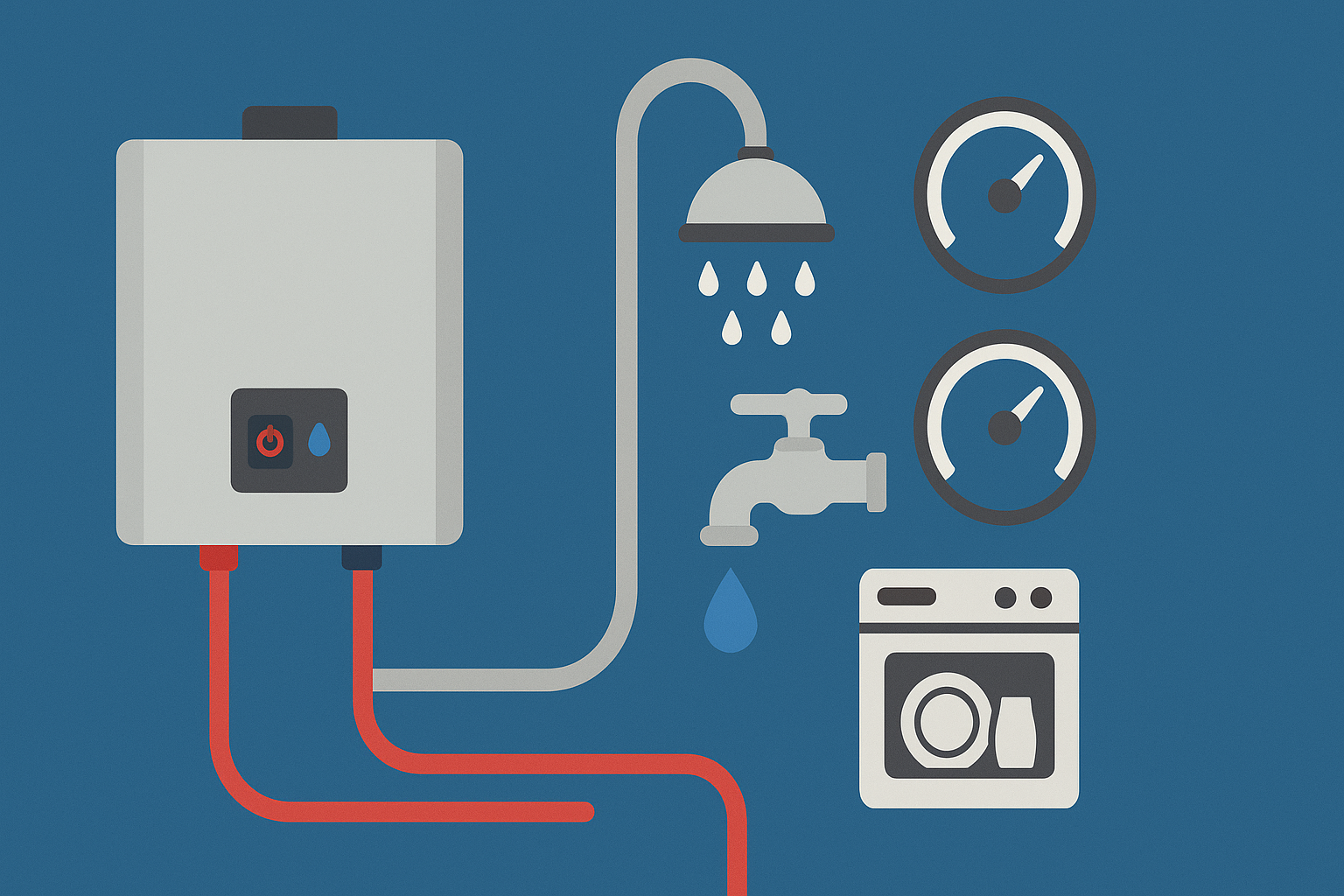
Proper sizing is crucial for tankless water heater performance. Unlike traditional tanks measured by storage capacity, tankless units are sized by flow rate (GPM) and temperature rise capability.
For detailed sizing calculations, read our comprehensive sizing guide.
🧮 Calculating Your Hot Water Needs
Step 1: Determine Peak Demand
List all hot water fixtures that might run simultaneously during your household's busiest times:
| Fixture | Flow Rate (GPM) |
|---|---|
| Standard shower | 2.0-2.5 |
| Low-flow showerhead | 1.5-2.0 |
| Rain showerhead | 3.0-4.0 |
| Bathroom sink | 0.5-1.0 |
| Kitchen sink | 1.0-1.5 |
| Dishwasher | 1.0-2.0 |
| Washing machine | 1.5-3.0 |
| Bathtub filling | 3.0-5.0 |
Step 2: Calculate Temperature Rise
Subtract your incoming water temperature from desired output temperature:
| Climate Zone | Temperature Rise Needed |
|---|---|
| Northern climates | 70°F rise (40°F → 110°F) |
| Central climates | 55°F rise (55°F → 110°F) |
| Southern climates | 40°F rise (70°F → 110°F) |
Use our interactive calculator to determine your exact sizing needs.
🏡 Sizing Examples by Home Type
Studio/1 Bedroom Apartment (1-2 people)
- Peak demand: 3.0-4.0 GPM
- Recommended gas unit: 6-7 GPM capacity
- Recommended electric unit: 18-24 kW
- Example scenarios: One shower + one sink simultaneously
2-3 Bedroom Home (3-4 people)
- Peak demand: 4.5-6.5 GPM
- Recommended gas unit: 7-9 GPM capacity
- Recommended electric unit: 24-27 kW
- Example scenarios: Two showers running simultaneously
Large Home 4+ Bedrooms (5+ people)
- Peak demand: 7.0+ GPM
- Recommended gas unit: 9+ GPM capacity
- Recommended electric unit: 27+ kW or multiple units
- Example scenarios: Multiple showers + kitchen + laundry
🌡️ Climate Considerations for Sizing
❄️ Cold Climate Adjustments: In areas where incoming water temperature drops below 45°F, increase your calculated size by 15-20% to maintain adequate performance during winter months.
⛰️ High Altitude Considerations: Gas units lose efficiency at elevations above 3,000 feet. Increase sizing by 10-15% for optimal performance.
🏆 Top Tankless Water Heater Brands and Models 2026
💎 Premium Tier ($1,500-$3,500)
🥇 Rinnai RU160iN
- Flow rate: 9.0 GPM
- Efficiency: 0.92-0.93 UEF
- Features: Wi-Fi connectivity, recirculation ready, scale detection
- Best for: Large homes with high hot water demand
- Warranty: 15 years heat exchanger, 5 years parts
🥈 Noritz EZ111DV
- Flow rate: 11.1 GPM
- Efficiency: 0.95 UEF
- Features: Dual stainless steel heat exchanger, internal pump ready, scale detection
- Best for: Premium installations with recirculation
- Warranty: 25 years heat exchanger, 5 years parts
Browse our best rated tankless water heaters for top performers.
🥉 Mid-Tier Excellence ($800-$1,500)
Rheem RTG-70DVLN-3
- Flow rate: 7.0 GPM
- Efficiency: Non-condensing
- Features: Direct vent, reliable operation
- Best for: Most residential applications
- Warranty: 12 years heat exchanger, 5 years parts
Takagi T-H3-DV-N
- Flow rate: 10.0 GPM at 35°F rise
- Efficiency: 0.95 UEF
- Features: Commercial-grade heat exchanger
- Best for: Heavy-use residential applications
- Warranty: 15 years heat exchanger, 5 years parts
💰 Budget-Friendly Options ($500-$800)
Rinnai V65iN
- Flow rate: 6.5 GPM at 35°F rise
- Efficiency: 0.82 UEF
- Features: Smart-Circ ready, compact design
- Best for: Small to medium homes
- Warranty: 10 years heat exchanger, 5 years parts
EcoSmart ECO 18
- Flow rate: 4.4 GPM at 35°F rise (electric)
- Efficiency: 0.99 UEF
- Features: Digital temperature control, compact
- Best for: Point-of-use applications
- Warranty: Limited lifetime
🔨 Installation Requirements and Costs
Professional installation is highly recommended for tankless water heaters due to complex requirements involving gas lines, electrical work, and proper venting. Read our installation tips for detailed guidance.
🏠 Installation Cost Breakdown (2026)
| Component | Cost Range |
|---|---|
| Gas tankless unit | $1,000-$3,500 |
| Electric tankless unit | $500-$1,500 |
| Professional installation | $1,000-$3,000 |
| Gas line upgrade | $500-$2,000 |
| Electrical panel upgrade | $1,000-$2,500 |
| Venting system | $300-$1,500 |
| Permits and inspections | $100-$500 |
📋 Pre-Installation Requirements
For Gas Units:
- Adequate gas supply (120,000+ BTU capacity)
- Proper ventilation system
- Gas line sizing verification
- Carbon monoxide detector installation
For Electric Units:
- Electrical panel capacity (200+ amp recommended)
- Dedicated circuit breaker
- Proper wire gauge (typically 8-10 AWG)
- GFCI protection
🔧 Maintenance and Troubleshooting
Regular maintenance is essential for optimal performance and longevity. Read our maintenance guide for detailed instructions.
🗓️ Annual Maintenance Tasks
- Descaling and flushing (every 6-12 months)
- Filter cleaning (every 3-6 months)
- Venting system inspection (annually)
- Gas line pressure testing (annually)
- Electrical connection inspection (annually)
🛠️ Common Issues and Solutions
| Problem | Possible Cause | Solution |
|---|---|---|
| No hot water | Power/gas supply issue | Check breaker/gas valve |
| Insufficient hot water | Undersized unit | Upgrade to higher capacity |
| Temperature fluctuations | Mineral buildup | Descale unit |
| Unit won't ignite | Gas supply/ignition issue | Professional service needed |
💰 Cost Analysis: Tankless vs Traditional
🏦 Upfront Investment Comparison
| System Type | Equipment Cost | Installation Cost | Total Initial Cost |
|---|---|---|---|
| Traditional Tank | $800-$2,000 | $500-$1,500 | $1,300-$3,500 |
| Tankless Gas | $1,000-$3,500 | $1,500-$3,000 | $2,500-$6,500 |
| Tankless Electric | $500-$1,500 | $1,000-$2,000 | $1,500-$3,500 |
📊 Long-Term Operating Costs
Annual operating costs vary significantly by region and usage patterns:
- Traditional tank systems: $400-$600/year
- Tankless systems: $250-$400/year
- Average annual savings: $150-$200
🎯 Break-Even Analysis (2026 Update)
Most tankless installations reach break-even within 4-7 years through energy savings. Factors affecting payback period:
- Initial installation cost difference
- Local energy prices
- Household hot water usage
- Available rebates and tax credits
- Note: the federal 25C tax credit expired Dec 31, 2025 — check state and utility programs
Use our cost calculator to determine your specific payback timeline.
🌍 Environmental Impact
Tankless water heaters offer significant environmental benefits:
🌱 Carbon Footprint Reduction
- 8-34% reduction in energy consumption
- Lower greenhouse gas emissions
- Reduced strain on electrical grid during peak hours
♻️ Sustainability Benefits
- Longer lifespan reduces landfill waste
- Recyclable components (copper, stainless steel)
- Energy-efficient operation reduces power plant demand
🏅 Energy Efficiency and Ratings
📊 Understanding Efficiency Ratings
| Rating System | Description | Typical Range |
|---|---|---|
| UEF (Uniform Energy Factor) | Overall efficiency measurement | 0.80-0.99 |
| Energy Star Certification | Minimum efficiency standards | UEF ≥ 0.95 (gas), ≥ 0.93 (electric) |
| AFUE (Annual Fuel Utilization Efficiency) | Gas units only | 80-99% |
🏆 Most Efficient Models 2026
Gas Units:
- Rinnai RU160iN: 0.96 UEF
- Noritz EZ111DV: 0.96 UEF
- Takagi T-H3-DV-N: 0.95 UEF
Electric Units:
- Stiebel Eltron Tempra 29 Plus: 0.99 UEF
- EcoSmart ECO 36: 0.99 UEF
- Rheem RTEX-24: 0.99 UEF
🔮 Future Technology Trends
🚀 Recent Innovations
Smart Home Integration
- Wi-Fi enabled controls and monitoring
- Mobile app temperature adjustment
- Usage pattern learning and optimization
- Integration with home automation systems
Advanced Efficiency Features
- Condensing technology for gas units
- Modulating burners for precise temperature control
- Heat recovery systems
- Improved heat exchanger designs
🔬 Emerging Technologies
Hybrid Systems
Combining tankless technology with small storage tanks for optimal efficiency and performance.
Heat Pump Integration
Next-generation systems combining heat pump technology with tankless heating for maximum efficiency.
AI-Powered Optimization
Machine learning algorithms that optimize performance based on usage patterns and preferences.
📋 Buying Guide and Recommendations
🎯 How to Choose the Right Tankless Water Heater
Step 1: Assess Your Needs
- Calculate hot water demand using our sizing guide
- Consider your home's layout and installation requirements
- Evaluate your budget for equipment and installation
Step 2: Choose Energy Source
- Gas: Higher flow rates, lower operating costs
- Electric: Easier installation, lower equipment costs
- Hybrid: Best of both worlds but higher complexity
Step 3: Select Appropriate Size
- Use our interactive calculator for precise sizing
- Consider future hot water needs
- Account for climate and altitude factors
Step 4: Compare Models
Browse our category pages for detailed comparisons:
- Best gas tankless water heaters
- Best electric tankless water heaters
- Best budget options
- Best premium models
- Best rated overall
Step 5: Plan Installation
- Get quotes from certified installers
- Review our installation tips
- Consider permits and inspection requirements
- Plan for any necessary upgrades
🏁 Final Recommendations
🥇 Best Overall: Rinnai RU160iN
Perfect for large homes with high hot water demand, offering 11.2 GPM capacity and smart features.
💰 Best Value: Rheem RTG-70DVLN-3
Excellent mid-tier option with 9.5 GPM capacity and reliable performance for most homes.
⚡ Best Electric: Stiebel Eltron Tempra 29 Plus
German engineering with 5.7 GPM capacity and 0.99 UEF efficiency.
🏠 Best for Small Homes: Rinnai V65iN
Compact design with 6.5 GPM capacity, perfect for 1-3 bedroom homes.
📞 Next Steps
Ready to make the switch to tankless? Here are your next steps:
- Take our interactive quiz to get personalized recommendations
- Use our calculator to estimate costs and savings
- Browse our product catalog for detailed specifications
- Read our buying guide for expert tips
- Review installation tips before purchasing
🎯 Market Predictions
The tankless water heater market is expected to grow significantly through 2026 and beyond, driven by:
- Energy efficiency mandates
- Smart home integration
- Environmental consciousness
- Technological improvements
Conclusion
Tankless water heaters represent the future of residential water heating, offering superior efficiency (8-34% energy savings), longevity, and convenience compared to traditional tank systems. While the initial investment is higher, the long-term benefits make tankless an excellent choice for most homes in 2026.
Key takeaways for 2026:
- Proper sizing is crucial for performance - use our sizing guide
- Professional installation ensures optimal operation - see our installation tips
- Regular maintenance extends lifespan significantly - follow our maintenance guide
- Smart features enhance convenience and efficiency
- 4-7 year payback period through $200/year energy savings
- The federal 25C tax credit expired Dec 31, 2025 — check state and utility rebates instead
- Some state-administered rebate programs remain available for qualified households (see the DSIRE database)
A note on incentives: The federal 25C tax credit expired on December 31, 2025. Some state and utility rebates remain available — check the DSIRE database for programs currently active in your area.
Whether you're building a new home or replacing an aging water heater, tankless technology in 2026 offers compelling advantages that make it worth serious consideration. With continued technological advancement, utility rebate programs, and proven energy savings, tankless water heaters are becoming the standard for modern homes focused on efficiency, reliability, and performance.
Ready to make the switch to tankless? Use our interactive quiz to find the perfect tankless water heater for your specific needs and budget.